


 Archaeology & History
Choosing between Monte Albán and Mitla is one of the most common dilemmas for travelers exploring Oaxaca’s archaeological treasures. Both sites offer profound connections to pre-Hispanic civilizations, yet they couldn’t be more different in atmosphere, architecture, and historical significance. Monte Albán dominates a mountaintop with sweeping valley views and monumental Zapotec plazas, while Mitla captivates visitors with intricate geometric mosaics and intimate Mixtec craftsmanship. This guide breaks down everything you need to know—from cultural context to logistics—so you can choose the ruins that match your travel style, or better yet, visit both.

Understanding the Historical Context: Zapotec vs Mixtec Civilizations
Monte Albán and Mitla represent two distinct chapters in Oaxaca’s ancient history. Monte Albán was the powerful capital of the Zapotec civilization, flourishing from around 500 BCE to 850 CE. This UNESCO World Heritage Site served as a political, economic, and ceremonial center controlling the Oaxaca Valley. The Zapotecs engineered the flattened mountaintop, constructed massive pyramids, and developed one of Mesoamerica’s earliest writing systems. Walking through Monte Albán feels like stepping into an empire’s seat of power.
Mitla, by contrast, rose to prominence after Monte Albán’s decline, reaching its peak under Mixtec influence between 900 and 1521 CE. The name derives from the Nahuatl word “Mictlán,” meaning “place of the dead,” reflecting its role as a sacred burial and ceremonial site. While smaller in scale, Mitla’s architectural achievements are extraordinary—its geometric stone mosaics, featuring over 100,000 individually cut pieces fitted without mortar, represent some of pre-Hispanic Mexico’s finest craftsmanship. The UNESCO recognition of Oaxaca’s cultural heritage acknowledges both sites’ significance.
Elena, a history teacher from Mexico City, shared her perspective: “Monte Albán made me feel the grandeur of an ancient civilization’s ambition. But Mitla? It made me appreciate the patience and artistry of individual craftsmen. Both moved me, just in completely different ways.”
Key Differences at a Glance
| Aspect | Monte Albán | Mitla |
|---|---|---|
| Primary Civilization | Zapotec | Mixtec (with Zapotec foundations) |
| Peak Period | 500 BCE – 850 CE | 900 – 1521 CE |
| Distance from Oaxaca City | 9 km (20-30 min drive) | 46 km (50-60 min drive) |
| Site Size | Large (40+ hectares) | Compact (5 main structures) |
| Architectural Highlight | Monumental pyramids, Grand Plaza, observatories | Geometric stone mosaics, palace complexes |
| Terrain | Mountaintop (extensive walking, stairs) | Flat valley floor (easier accessibility) |
| Ideal Visit Duration | 2.5 – 4 hours | 1.5 – 2.5 hours |
| Shade Availability | Minimal (exposed) | Moderate (some covered areas) |
| Best For | Epic views, empire-scale architecture, photography | Detailed artistry, cultural depth, combination tours |
Monte Albán: The Mountaintop Empire
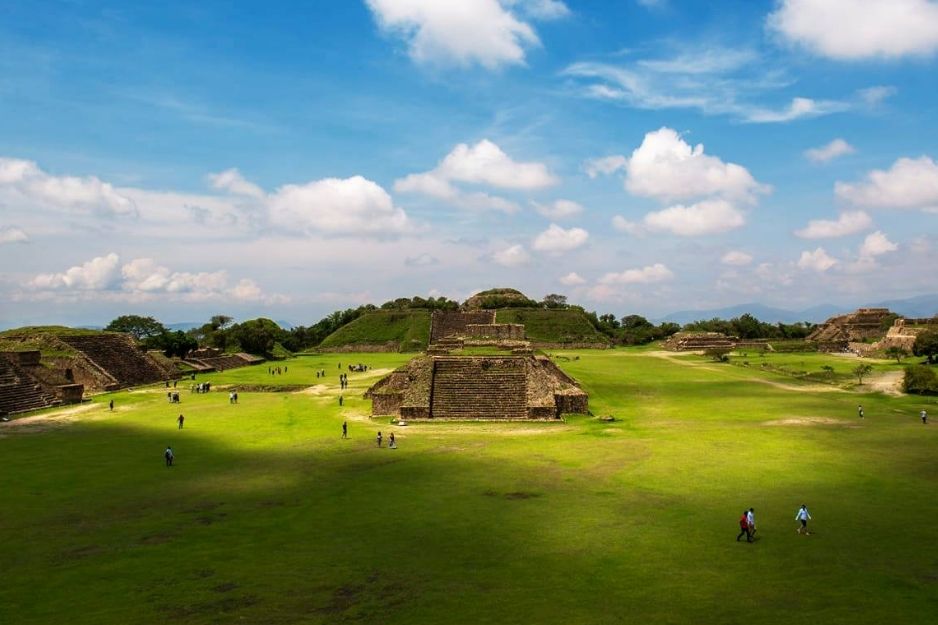
Monte Albán commands attention before you even arrive. Perched 400 meters above the Oaxaca Valley floor, this archaeological zone offers 360-degree panoramas that remind visitors why the Zapotecs chose this strategic location. The site’s centerpiece, the Gran Plaza, stretches 300 meters long and 200 meters wide, flanked by pyramids, temples, and the famous ball court.
Key structures include:
- Platform South: The site’s largest pyramid, offering elevated viewpoints across the entire complex
- Building J: An arrow-shaped observatory aligned with celestial events, showcasing advanced astronomical knowledge
- Los Danzantes: Stone slabs carved with figures once thought to be dancers, now understood as defeated enemies or sacrifice victims
- Tomb 7: Where one of Mesoamerica’s richest treasure troves was discovered (artifacts now displayed in Oaxaca’s cultural museums)
- Ball Court: One of the earliest examples in Mesoamerica, central to Zapotec ritual life
The experience at Monte Albán is visceral and expansive. You’ll climb steep stone staircases, walk across vast open plazas under the sun, and encounter the weight of centuries in every carved stone. The site museum provides context with artifacts, ceramics, and jade pieces that bring the Zapotec world into focus. Plan to arrive early—before 10 AM—to avoid crowds and intense midday heat. The Secretaría de Turismo de Oaxaca offers updated visitor guidelines and seasonal recommendations.
Monte Albán pairs naturally with visits to nearby artisan villages. Many travelers combine the archaeological site with Arrazola’s alebrije workshops and San Bartolo Coyotepec’s black pottery studios, creating a full-day cultural immersion that balances ancient history with living traditions.
Mitla: The Mosaic Masterpiece
Mitla operates on an entirely different scale and sensibility. Where Monte Albán impresses through monumental scale, Mitla mesmerizes through intricate detail. The site consists of five main groups of structures, with the Grupo de las Columnas (Group of Columns) being the most spectacular and accessible to visitors.
What sets Mitla apart:
- Geometric Mosaics: Fourteen distinct mosaic patterns adorn the walls, created from thousands of individually carved stones fitted together like three-dimensional puzzles. Each pattern carries symbolic meaning related to Mixtec cosmology
- Hall of Columns: Six monolithic columns support the roof of this ceremonial space, where high priests once conducted rituals
- Palace of the Columns: The most ornate structure, featuring stacked friezes and the famous “Column of Life”—a pillar visitors traditionally embrace to measure their remaining years based on how far their arms can reach
- Underground Tombs: Cruciform chambers beneath the structures served as burial sites for Mixtec nobility
- Church of San Pablo: Built by Spanish colonizers directly atop pre-Hispanic structures, symbolizing the violent cultural transition
Mitla feels more intimate than Monte Albán. You can study the mosaic patterns up close, run your fingers along ancient stone (where permitted), and appreciate the human effort behind each precisely cut piece. The site’s compact layout means less walking and easier navigation for travelers with mobility considerations. Photography enthusiasts find endless inspiration in the geometric patterns, play of light and shadow, and the striking contrast between pre-Hispanic precision and colonial-era construction.
The modern town of Mitla sits adjacent to the ruins, offering authentic dining options, local markets, and artisan cooperatives selling traditional textiles. Most visitors combine Mitla with nearby attractions: Hierve el Agua’s petrified waterfalls, Teotitlán del Valle’s renowned weaving traditions, and ancestral mezcal distilleries create a diverse day trip that showcases Oaxaca’s natural and cultural wealth.
Practical Logistics: Getting There and What to Bring
Both archaeological sites are accessible as day trips from Oaxaca City, but they require different logistical approaches.
Reaching Monte Albán
Monte Albán sits just 9 kilometers west of Oaxaca City’s historic center. Options include:
- Colectivo buses: Depart from Hotel Rivera del Ángel (Mina Street) every 30 minutes from 8:30 AM to 5:30 PM. Return buses run on the same schedule. This is the most economical option but requires flexibility with timing
- Taxi or rideshare: A direct taxi takes 20-30 minutes depending on traffic. Negotiate return pickup time or use ride apps for flexibility
- Guided tours: Include transportation, bilingual guides, and often combine Monte Albán with artisan village visits for a comprehensive experience
- Rental car: Offers maximum independence and the ability to explore at your own pace, though parking can be limited during peak season
Reaching Mitla
Located 46 kilometers southeast of Oaxaca City, Mitla requires more travel time:
- Second-class buses: Depart frequently from Oaxaca’s second-class terminal (Central de Autobuses de Segunda Clase). Journey takes 60-75 minutes. Return buses run until early evening
- Colectivos: Shared vans offer a faster, slightly more comfortable alternative, departing when full from the same terminal area
- Organized tours: The most stress-free option, especially when combined with Hierve el Agua, Teotitlán del Valle, and mezcal tastings. Guides provide historical context and handle all logistics
- Private driver: Ideal for small groups wanting flexibility to set their own schedule and add spontaneous stops
Essential Items for Both Sites
- Sun protection: Wide-brimmed hat, high-SPF sunscreen, sunglasses (both sites have intense sun exposure)
- Comfortable walking shoes with good grip (Monte Albán has steep, uneven stairs)
- Reusable water bottle (stay hydrated at altitude and in heat)
- Light, breathable clothing in layers (mornings can be cool, afternoons hot)
- Cash in small bills (entrance fees, tips, local vendors accept minimal card payments)
- Camera or smartphone with full battery (both sites offer spectacular photo opportunities)
- Small backpack for carrying essentials comfortably
- Guidebook or downloaded maps (cell service can be spotty)
According to INEGI climate data, Oaxaca’s dry season (November through April) offers the most comfortable conditions for archaeological exploration, with clear skies and moderate temperatures. The rainy season (May through October) brings afternoon showers but also lush landscapes and fewer crowds.
Which Ruins Match Your Travel Style?
The choice between Monte Albán and Mitla—or the decision to visit both—depends on your interests, physical capabilities, and available time.
Choose Monte Albán if you:
- Want to experience the grandeur and scale of an ancient empire’s capital
- Love panoramic landscapes and dramatic photography opportunities
- Appreciate monumental architecture and urban planning
- Have limited time (closer to Oaxaca City for a half-day visit)
- Enjoy extensive walking and climbing (the site requires physical activity)
- Prefer sites that feel more isolated and contemplative
- Are interested in early Mesoamerican civilizations and astronomical alignments
Choose Mitla if you:
- Appreciate detailed craftsmanship and artistic precision
- Want a more compact, manageable site (less walking, easier navigation)
- Plan to combine ruins with natural wonders like Hierve el Agua
- Enjoy cultural immersion in authentic Oaxacan towns
- Prefer sites with more shade and easier accessibility
- Are fascinated by Mixtec culture and later pre-Hispanic periods
- Want to explore mezcal traditions and weaving villages in the same day
Visit Both Sites if you:
- Have 3-5 days in Oaxaca and want comprehensive archaeological exploration
- Want to understand the full scope of Oaxaca’s pre-Hispanic civilizations
- Enjoy contrasting architectural styles and historical periods
- Can dedicate separate days to each site for proper appreciation
- Want to combine archaeology with diverse cultural experiences
Marco, a photographer from Italy, reflected on his choice: “I visited both over two days. Monte Albán gave me those epic wide shots with mountains in every direction. Mitla gave me the macro details—those geometric patterns are addictive to photograph. If you’re serious about understanding Oaxaca’s history, you need both perspectives.”
Beyond the Ruins: Completing Your Oaxaca Experience
Neither Monte Albán nor Mitla exists in isolation. Oaxaca’s archaeological sites integrate beautifully with the region’s other treasures, creating rich multi-dimensional experiences. After immersing yourself in ancient Zapotec and Mixtec history, consider extending your exploration to:
- Artisan Villages: Teotitlán del Valle’s master weavers create tapestries using ancestral Zapotec techniques and natural dyes. San Bartolo Coyotepec’s black pottery continues pre-Hispanic ceramic traditions. Arrazola’s alebrije carvers transform copal wood into fantastical creatures
- Natural Wonders: Hierve el Agua’s petrified waterfalls create surreal landscapes just beyond Mitla. The Sierra Juárez mountains offer cloud forests, glass viewpoints, and indigenous Zapotec communities maintaining traditional lifestyles
- Mezcal Culture: Ancestral distilleries around Santiago Matatlán and Santa Catarina Minas reveal the deep cultural significance of Oaxaca’s iconic spirit, far beyond tourism trends
- Living History: Weekly markets in Tlacolula and Ocotlán demonstrate how pre-Hispanic trading traditions continue today, with indigenous languages spoken and traditional goods exchanged
Many travelers find that understanding pre-Hispanic civilizations enhances their appreciation of contemporary Oaxacan culture. The geometric patterns in Mitla’s mosaics reappear in modern textiles. The astronomical knowledge displayed at Monte Albán connects to indigenous agricultural calendars still used today. The ceremonial spaces in both sites echo in Catholic-indigenous syncretism visible throughout Oaxaca’s villages.
Frequently Asked Questions
Can you visit both Monte Albán and Mitla in one day?
Yes, but it requires an early start and efficient logistics. A typical combined itinerary begins with Monte Albán (8:00 AM – 11:30 AM), followed by travel to Mitla (12:30 PM – 2:30 PM). However, this rushed schedule doesn’t allow for deep exploration or combination with other attractions. Most travelers prefer dedicating separate days to each site for fuller appreciation. If time is limited, organized tours streamline logistics and maximize your experience.
Which site is better for families with young children?
Mitla tends to be more family-friendly due to its compact layout, flatter terrain, and shorter visit duration. Children can touch many of the stone mosaics (where permitted) and appreciate the geometric patterns. Monte Albán requires extensive walking, stair climbing, and longer endurance under exposed sun. However, older children and teenagers often find Monte Albán’s scale and viewpoints more impressive. Consider your children’s ages, energy levels, and interests when choosing.
Do I need a guide, or can I explore independently?
Both options work, depending on your preferences. Independent exploration allows flexible pacing and quiet contemplation. However, certified guides dramatically enhance understanding—they decode architectural meanings, share historical narratives, point out easily missed details, and connect ancient civilizations to contemporary Oaxacan culture. Guides are available for hire at both site entrances, or you can book ahead through organized tours. Even history enthusiasts often report that guided visits revealed layers they would have missed alone.
What’s the best time of year to visit Oaxaca’s archaeological sites?
November through April offers optimal conditions: clear skies, moderate temperatures, and minimal rain. December through February brings cooler mornings (bring layers) but perfect midday conditions. March through May sees higher temperatures—arrive at opening time to avoid peak heat. The rainy season (June through October) means afternoon showers, lush vegetation, and fewer tourists. Avoid major Mexican holidays (Easter week, Christmas, New Year’s) when domestic tourism peaks. Weekday mornings always offer the quietest experiences.
Are the ruins accessible for travelers with mobility limitations?
Mitla offers significantly better accessibility with flat terrain, paved pathways, and compact layout. Most main structures are viewable without extensive walking. Monte Albán presents major challenges—steep stairs, uneven surfaces, long distances between structures, and altitude. Wheelchair access is extremely limited at Monte Albán. Travelers with mobility concerns should prioritize Mitla and consider hiring private transportation with a driver who can adjust the itinerary as needed.
Can I combine archaeological sites with adventure activities?
Absolutely. Oaxaca’s diversity allows seamless combinations of history, culture, and adventure. After exploring ruins, travelers enjoy hiking to hidden waterfalls, mountain biking in the Sierra Juárez, exploring underground caves in Santiago Apoala, or surfing at Puerto Escondido. Sierra Juárez tours combine Zapotec villages with cloud forest trekking. Santiago Apoala expeditions merge natural beauty with archaeological sites less visited than Monte Albán or Mitla.
Information may change; please confirm schedules, regulations, and availability before booking. For legal, environmental, or safety matters, consult local authorities or official sources. For personalized tour planning and questions about combining archaeological sites with other Oaxaca experiences, visit our complete tour offerings or contact our local team.


