


 Archaeology & History
Everyone knows Monte Albán. But Oaxaca’s ancient world doesn’t begin and end with that hilltop citadel. Scattered across the Central Valleys and beyond lie Zapotec and Mixtec sites that see only a fraction of the visitors they deserve — windswept platforms, painted tombs, carved stone ballcourts, and hilltop fortresses where the silence feels almost sacred. If you’re ready to step off the well-worn path and dig deeper into Oaxaca’s pre-Columbian past, these are the ruins worth rearranging your itinerary for.
Why Most Travelers Only See Monte Albán (And What They’re Missing)
Monte Albán is genuinely extraordinary — a UNESCO World Heritage Site and one of the earliest cities in Mesoamerica. But the very fame that draws thousands of visitors each week also concentrates tourist attention on a single point in a landscape thick with ancient history. The Central Valleys of Oaxaca were home to one of the most complex civilizations in pre-Columbian Mexico, and evidence of that world stretches for dozens of kilometers in every direction.
The sites described below are not consolation prizes for people who couldn’t get to Monte Albán. They are complementary destinations with their own distinct character — different epochs, different functions, different aesthetics. Visiting them alongside the better-known sites gives you a far richer picture of the Zapotec and Mixtec worlds.

Most can be reached on a day trip from Oaxaca City, often combined with artisan villages, mezcal tastings, or nature stops along the same road. Our Hierve el Agua, Mitla Ruins & Mezcal day tour already incorporates several of these valleys and gives you a sense of how naturally history, craft, and landscape flow together here.
The Hidden Archaeological Sites Worth Your Time
1. Yagul — The Fortress Nobody Talks About
Perched on a rocky outcrop about 36 kilometers east of Oaxaca City, Yagul is arguably the most underrated site in the Central Valleys. It was a major Zapotec political and religious center, likely reaching its peak between 500 and 900 CE, and it continued to be occupied well into the Mixtec period.
What makes Yagul special is the combination of scale and solitude. The site includes one of the largest ballcourts in Oaxaca, an intricate palace complex, multiple tombs, and — best of all — a hilltop fortress with sweeping panoramic views across the valley. On a clear morning, you can see for kilometers in every direction without another tourist in sight. The cacti-studded hillside and the distant silhouette of Monte Albán make for extraordinary photographs.
Yagul sits just a few kilometers from Mitla, making it a natural addition to any visit to the Tlacolula Valley. It’s part of the same UNESCO World Heritage Zone as Monte Albán.
2. Lambityeco — The Site With the Best Stone Faces
Just off the road between Oaxaca City and Mitla, Lambityeco is easy to miss — it’s small, it lacks the drama of Monte Albán’s elevated position, and it doesn’t have a flashy reputation. But what it does have is exceptional: a series of remarkably well-preserved stucco friezes and sculpted portraits of Zapotec rulers and rain deities (Cocijo) that are among the finest examples of Zapotec facial sculpture anywhere.
Occupied between roughly 700 and 900 CE, Lambityeco is thought to have been a center for salt production — an enormously valuable commodity in pre-Columbian Mesoamerica. The site is compact and can be explored in under an hour, which makes it a perfect add-on stop rather than a full-day commitment. The quality of the stonework rewards close attention.
3. Dainzú — Ballplayers Carved in Stone
Dainzú doesn’t get the recognition it deserves. Located about 22 kilometers southeast of Oaxaca City, this early Zapotec site dates to around 700–200 BCE — making it contemporaneous with the earliest phases of Monte Albán — and it contains something genuinely unusual: a series of carved stone slabs depicting ballplayers in action, complete with helmets, gloves, and the kind of fierce, dynamic postures that make you want to know more about the game being played.
The main pyramid at Dainzú offers good valley views, and the site’s age gives it a raw, elemental quality that more developed sites sometimes lose. There’s a small jaguar temple worth seeking out on the hillside above the main platform.
4. Zaachila — Sacred Ground of the Mixtec
Zaachila, about 18 kilometers southwest of Oaxaca City, was the last capital of the Zapotec kingdom and later an important Mixtec ceremonial center. The main attraction here is not a pyramid but a pair of underground tombs — Tomb 1 and Tomb 2 — that contain extraordinary Mixtec-style carvings, including owls, turtles, and serpents rendered in a level of detail rarely preserved elsewhere.
The town itself is worth the trip independent of the ruins: Zaachila hosts one of the best Thursday markets in the Oaxacan valleys, filled with local produce, regional food, and artisan crafts. Combining the tombs with the market makes for a deeply layered day.
5. San José el Mogote — Where It All Began
Before Monte Albán, there was San José el Mogote. This site, located about 12 kilometers northwest of Oaxaca City in the Etla Valley, was the dominant settlement in the region from roughly 1500 BCE to the founding of Monte Albán around 500 BCE. It may well be the birthplace of writing and calendrical systems in Oaxaca.
Today the site is not heavily developed for tourism — which is part of its appeal. A small community museum in the nearby town of Guadalupe Etla houses some of the artifacts excavated here, including what some researchers believe to be the earliest known carved inscription in Mesoamerica. For archaeology enthusiasts, this is sacred ground.
6. Mitla — The City of the Dead
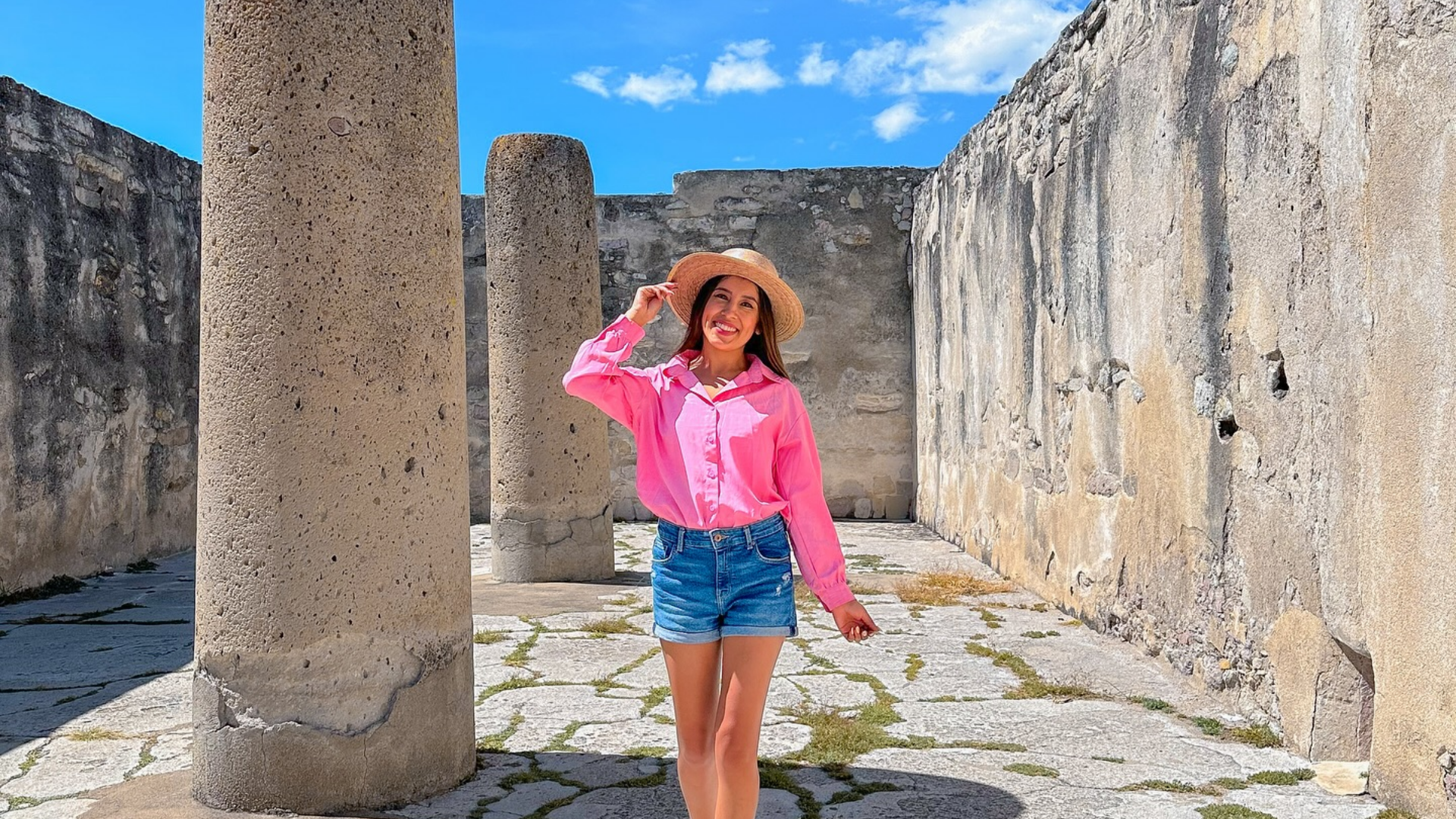
Mitla is not exactly hidden — it’s well known and regularly visited — but it is dramatically underappreciated relative to its importance. While Monte Albán was a ceremonial and political capital, Mitla was the spiritual capital of the Zapotec world, the place where the high priest resided and the portal to the underworld was believed to exist.
What sets Mitla apart architecturally is its extraordinary mosaic stonework: intricate geometric patterns called grecas, assembled from thousands of individually cut stone pieces without mortar. No two panels are the same. It is one of the finest examples of pre-Columbian decorative architecture in all of Mexico, and yet visitors often spend less time here than at Monte Albán.
Our Hierve el Agua, Mitla & Mezcal day tour combines Mitla with the stunning natural rock formations of Hierve el Agua and a stop in the weaving village of Teotitlán del Valle — a combination that captures three of the valley’s most compelling experiences in a single day.
Comparing the Sites: Logistics, Experience & Best Pairings
| Site | Distance from Oaxaca City | Time Needed | Difficulty | Best Paired With | Highlight |
|---|---|---|---|---|---|
| Yagul | ~36 km east | 2–3 hours | Moderate (hilltop climb) | Mitla, Lambityeco | Fortress views, ballcourt |
| Lambityeco | ~28 km east | 45–60 min | Easy | Yagul, Tlacolula market | Stucco portraits, friezes |
| Dainzú | ~22 km southeast | 1–1.5 hours | Easy–Moderate | Tlacolula road stops | Ballplayer carvings |
| Zaachila | ~18 km southwest | 1.5–2 hours | Easy | Thursday market | Mixtec tombs |
| San José el Mogote | ~12 km northwest | 1–1.5 hours | Easy | Etla market, Atzompa | Earliest Oaxacan inscription |
| Mitla | ~44 km east | 1.5–2.5 hours | Easy | Hierve el Agua, Teotitlán | Mosaic stonework (grecas) |
Planning Tips: How to Visit More Than One Site in a Day
- Take the Tlacolula Valley route. The road east of Oaxaca City passes Dainzú, Lambityeco, Yagul, and Mitla in sequence — combine two or three in a single half-day drive with easy stops in between.
- Start early. Most sites open at 9:00 AM and close by 5:00 PM. Arriving early means softer light for photography and cooler temperatures for hilltop sites like Yagul.
- Bring water and sunscreen. There’s minimal shade at most archaeological sites. A hat is essential from March through October.
- Hire a knowledgeable local guide. Most of these sites have no explanatory signage in English. A guide transforms a confusing field of platforms into a living story.
- Check seasonal road conditions. During rainy season (June–October), unpaved access roads to some sites can be challenging. Verify conditions before heading out.
- Combine with craft villages. Teotitlán del Valle (rugs), San Bartolo Coyotepec (black clay pottery), and Arrazola (alebrijes) are all close to these sites and make the day feel more complete.
- Respect the sites. Do not climb restricted structures, touch carved stonework, or remove any material. INEGI and federal heritage authorities protect these zones under Mexican law.
A Traveler’s Story: Finding Yagul by Accident
“We had planned to go straight to Mitla and come back. But our guide mentioned Yagul almost as an afterthought — ‘it’s just up the hill, five minutes.’ We ended up spending two hours there. The fortress at the top was completely empty except for a pair of vultures circling overhead. We could see Monte Albán in the distance. It was one of those travel moments where you feel genuinely lucky — like you found something the guidebook forgot to mention.”
— Sarah & Marco, travelers from Germany and Italy
Going Further: Archaeological Oaxaca Beyond the Central Valleys
The Central Valleys concentrate most of Oaxaca’s accessible archaeological heritage, but the state is far larger and more diverse than those 44 kilometers of road east of the city. The Sierra Juárez — the mountain range visible from the city on clear days — contains numerous communities with deep indigenous roots and pre-colonial histories. Our Glass Viewpoint & Mountain Villages tour through the Northern Sierra takes you into that world, past Guelatao (birthplace of Benito Juárez) and through mountain communities that have maintained Zapotec traditions for centuries.
For those drawn to remote landscapes and less-visited terrain, Santiago Apoala — a hidden canyon village deep in the Mixteca Alta — is believed by some Mixtec traditions to be the place of human origin. It has no major excavated archaeological site, but the landscape itself feels ancient and charged with meaning. Our Apoala Falls & Mountains tour explores this extraordinary corner of Oaxaca.
You can find official information about cultural heritage protection and tourism in the state through Oaxaca’s Secretaría de Turismo.
Frequently Asked Questions
Are these sites safe to visit independently?
Most are — they are federally administered open-air sites with INAH (National Institute of Anthropology and History) staff on site. However, navigation between sites, understanding what you’re seeing, and reaching some of the more remote locations is significantly easier and richer with a local guide.
Which site should I prioritize if I only have time for one?
If you’ve already seen Monte Albán: Yagul, for the combination of dramatic landscape and genuine solitude. If you haven’t: Mitla, which rivals Monte Albán for architectural significance and fits naturally into the Tlacolula Valley day.
Can I visit Yagul and Mitla in the same day?
Absolutely. They’re about 8 kilometers apart on the same highway. You can also add Lambityeco as a quick stop between them. Our Hierve el Agua, Mitla & Mezcal tour covers much of this corridor in a single comfortable day trip.
Do the sites have good explanatory signage?
Signage varies. Monte Albán has good Spanish and English labels; Mitla has basic signage; Yagul, Lambityeco, Dainzú, and San José el Mogote have minimal interpretation. This is one of the strongest arguments for booking a guided tour.
What is the best season to visit archaeological sites in Oaxaca?
The dry season (November through May) offers the most comfortable conditions — clear skies, minimal dust, and no risk of rain turning unpaved roads to mud. The rainy season (June through October) is lush and green, which can be beautiful, but afternoon storms are common and some hilltop sites become slippery.
Are the sites appropriate for children?
Most are. Flat sites like Lambityeco and Mitla are very family-friendly. Yagul involves a significant uphill walk and is better suited for older children and teens. Bring snacks, water, and patience — open archaeological sites in the Oaxacan sun can be intense for small children by midday.
Conclusion
Oaxaca’s archaeological wealth extends far beyond the famous hilltop silhouette of Monte Albán. From the ballplayer carvings at Dainzú to the stucco portraits at Lambityeco, from the mosaic walls of Mitla to the windswept fortress at Yagul, each site tells a different chapter of a civilization that lasted thousands of years. The tourists who take the time to explore this broader landscape come away with something rare: a genuine sense of depth. These aren’t backup plans — they’re the real thing, waiting quietly for the traveler willing to look a little closer.
Information may change; please confirm schedules, regulations, and availability before booking.
For legal, environmental, or safety matters, consult local authorities or official sources.
Visit our tours page or contact us for the latest details.


